|
|
|
|
|
|
|
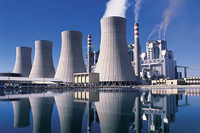 A
new and extensive economic program has been initiated by the beginning of 2000 and this program has been in progress
in Turkey, in order to decrease the inflation and to reassure the improvement medium in economic field in Turkey.
In the contents of this economic program, besides the applications of a severe financial policy and the execution
of extensive structural reforms, in order to descend the high inflation expectations rapidly, the exchange values
are pre - determined according to the aimed inflation and expressed beforehand and the cash policy had been set
to a spectrum in which the liquidity expansion is dependant on foreign resource inlet. A
new and extensive economic program has been initiated by the beginning of 2000 and this program has been in progress
in Turkey, in order to decrease the inflation and to reassure the improvement medium in economic field in Turkey.
In the contents of this economic program, besides the applications of a severe financial policy and the execution
of extensive structural reforms, in order to descend the high inflation expectations rapidly, the exchange values
are pre - determined according to the aimed inflation and expressed beforehand and the cash policy had been set
to a spectrum in which the liquidity expansion is dependant on foreign resource inlet.
At the application of the program, important steps are taken in the field of structural
reforms and to decrease or limit the public losses. At the coverage of the structural reforms, the social security
system encountering major losses for long periods are rearranged and important steps were taken in order to obtain
the balance between the actives and passives of the system. The first interference of direct income support system
in the field of agriculture had been taken and the trials at the pilot areas were resulted in affirmative outcomes
and the credit interest rates were determined according to the resource costs. By the foundation of Banking Supervision
and Arrangement Association as a result of the reform in financial sector, it is planned and aimed to gather the
activities of supervision, arrangement and surveillance of the banking sector under a sole authority. Regarding
the privatization activities, 51 percent of the Petroleum Office sold as a block and 31.5 percent of TÜPRAÞ
was sold by the public submission in the year 2001. Besides, the income obtained from the cellular phone license
sales were higher than expected.
|
|
|
|
|
|
|
|
The Central Bank which is in charge of directing the cash policies in Turkey is
also responsible from arranging the cash demand, crediting other private or government banks, forming the tools
of cash policy and determining the exchange values. The exchange rates originate in the free market conditions
under the supervision of the Central Bank. The Undersecretariat of Treasury plays an important and major role in
the policies of the Central Bank. This institution especially assists the directing and executing of the banking
system.
The financial policies executed in the period following 1980 had canceled the limiting
arrangements present in the sector and by this fact, the competition medium was improved. Liberal policy applications
as facilitating the income and outcomes of local and foreign banks and lifting the limitations at the interest
rates were initiated. The share of the banking sector among the financial sector could be expressed above 70 percent
and if the Central Bank is included inside this banking sector, this amount could reach up to 90 percent. The banks
acting inside Turkey had rapidly diversified their customer services, had entered into a technological competition
medium and directed towards the electronic banking in order to ascend the quality of their service.
|
|
|
|
|
|
|
|
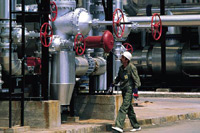 Starting
from 1963, the basic aims of the five year planned periods were determined as " high growth rates" and
" structural alterations in the aspects of industrialization" Starting
from 1963, the basic aims of the five year planned periods were determined as " high growth rates" and
" structural alterations in the aspects of industrialization"
The adopted industrialization strategies and the applied financial policies display
major alterations in the periods before and after 1980. The applied policies during and after 24 January 1980 Economic
Stability Program had variations when compared to the preceding stability programs executed in every 8 - 10 years
and this program reflects more fundamental alterations in the economic and industrialization policies. Therefore,
radical variations were applied to the cash, finance, foreign trade and exchange rate policies and instead of "
import installation oriented - devoted to local market" industrialization, a transformation in the direction
of " based on export - devoted to foreign markets" industrialization had been initiated and executed.
After the period following 1980, the support of the industrial sector had been concentrated
in the level of production and the foreign capital incitements were increased. This structural alteration in the
industry sector had been tried to be applied by increasing the intermediate and investment production at the production
industry. Highway vehicles, non - electronic machinery and metal property production are among the first lines
of investment properties and in the production of intermediate products, the major share was taken by petroleum
and iron - steel products. And in addition, the importation of the intermediate and investment products were greatly
facilitated. Therefore, the usage of new technologies and modern marketing methods required by the industry spread
inside the country.
Especially after the second half of the 1980s, the governments had planned and executed
the "construct - manage - transfer" model, in order to accelerate the infrastructure investments at industry
sector and to cover the resource requirements in more convenient conditions. When capital market is taken into
account, the necessary pre - conditions to divert small possessions to industry were arranged precedencely and
the Capital Marketing Committee was founded by a law issued in 1981. Parallel to these precautions, the banking
services were modernized and in order to accelerate the international operations necessary legal arrangements were
realized. Great importance was paid to improve transportation and communication services which are counted as prerequisites
of industrialization policy.
|
|
|
|
|
|
|
|
The primary energy sources used as energy consumption in Turkey could be counted
as charcoal, lignite, petroleum, natural gas, hydrologic and geothermal energy, wood, animal and plant churns and
in addition to these primary sources, solar energy is also used. The electrical energy and the coke coal is utilized
as secondary energy sources. The studies for benefiting nuclear energy is still in progress. In order to cover
the increasing energy requirement and the expanses of investments required by energy sector in intermediate and
long terms, the increasing role of private sector is understood and studies concerning about the participation
of private sector by the side of governmental resources is initiated and the privatization studies in the electric
sector had been accelerated.
|
|
|
|
|
|
|
|
Turkey is a extremely rich country when the variation of mineral deposits and reserves
are taken into account.
Today, production of 53 different mineral deposits and mines are realized in the mining
sector in Turkey. The mineral and mine production in the public sector is heavily directed to the fuels and metallic
ores as the private sector is concentrated to the production of industrial minerals. The annual average production
of charcoal is above two and a half million tons. The only organization producing charcoal is Turkey Charcoal Association
General Directorate and this association continues its activities in five establishments by the method of underground
mining. The lignite ore deposits are encountered in nearly all regions of Turkey. Turkey is the seventh country
of the world in lignite reserves and at the sixth order in the production process. The assistance of the lignite
mining to economy is basically in the field of energy production. The lignite and unrefined petroleum production
in the sector covers approximately 60 percent of the total production. Also enterprises concerning the search and
production for petroleum in foreign countries is realized. In this concept, although limited, petroleum production
studies in the common determined fields at Egypt and Khazakistan is still in progress.
|
|
|
|
|
|
|
|
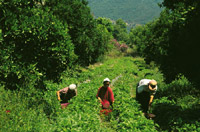 As
Turkey is a very convenient country for growing and harvesting agricultural products because of the geographic
and climate conditions are taken into account, Turkey is one of the rare countries which is self sufficient in
the production of agricultural products and foodstuff. The growth increase in this sector is accelerated rapidly
after the application of the planned period initiated in 1963 and the annual growth rate is calculated for long
terms is realized as average 3.3 percent. As
Turkey is a very convenient country for growing and harvesting agricultural products because of the geographic
and climate conditions are taken into account, Turkey is one of the rare countries which is self sufficient in
the production of agricultural products and foodstuff. The growth increase in this sector is accelerated rapidly
after the application of the planned period initiated in 1963 and the annual growth rate is calculated for long
terms is realized as average 3.3 percent.
The same rate is above the average annual population increase (2.2 percent) in the
same period. The increase in the production was greatly dependent on the increase of planting fields and the increase
in the number of the animals used before the planned period. However, the increase after 1963is relevant with the
positive improvements in the agricultural technologies and inlet usage and therefore the increase in the productivity.
The productivity increased in time relevant with the production improvements as secondary production, improvement
of production method, usage of chemical fertilizers, agricultural drugs, irrigation, artificial seeding, bait and
the number of the breeding animals and mechanization. The positive activities of the private sector in the purchase
of seeds after 1990 is an important factor effecting the increase of the productivity of the vegetal products Again
in the same period major successions were obtained in the live stock breeding field by usage of artificial intercourse
increasing productivity and in the contention with the animal diseases and detrimental.
The infrastructure facilitation supplied by the government in the field of irrigation
and soil processing assisted the positive improvement of agriculture in Turkey in recent years. As an example,
after the completion the Southeast Anatolia Project (GAP) in the 21st Century, it would be possible to irrigate
1.7 million hectares of agricultural field of the 3.1 million hectares present in the region. Therefore the variety
of the agricultural products would increase and according to this fact with the new technologies installed to the
developing agriculture oriented industry in the region would increase the competition power of the regional economy
both in inner market and foreign market.
The portion of the agriculture sector value added tax in the gross domestic production
had decreased to 17 percent with current prices in 1998, as this portion vas determined to be 26.1 percent in 1980.
The portion in the civil employment is about 45 percent. The decrease of the portion of the agricultural sector
in the gross domestic production do not definitely mean that the productivity of the agricultural sector is decreased.
As a result of the concentration on industrialization policies employed in Turkey, the portion of the industrialization
in the gross domestic production had increased. Therefore parallel to the improvements in the industry sector new
and modern technologies are started to be used in agriculture sector and new management understandings have developed.
The export of the agricultural products in 1998 had exceeded five billion dollars.
|
|
|
|
|
|
|
|
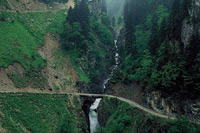 26
percent of Turkey is covered by the forest regimes. 26
percent of Turkey is covered by the forest regimes.
The area covered by fine quality and productive forests form only a very low ratio
of 13 percent. The productive forest area per person in the country is 0.14 hectares.
The average annual wood production in the forestry sector by public and private sectors
is approximately 29 million m3 . Approximately 68 percent of this wood production is used as fuel wood. In order
to cover the inner market demands, important amounts of wood is imported every year starting from 1985.
|
|
|
|
|
|
|
|
As the surface area of Turkey is wide, three borders are surrounded by seas and
as Turkey is a passageway country between Asia and Europe, the transportation sector holds a major importance in
the economy of the country. The transportation sector in Turkey is composed of land, sea, air, railroad and pipeline
transportation activities. The studies concerning the improvement and coordination of inland and foreign services
of the transportation sector is supervised and executed by the Ministry of Transportation. Parallel to the new
developments, studies of founding a new separate sub unit in charge of coordination between the organizations acting
at the transportation sub sectors under the control of the Ministry of Transportation is in progress. The number
of employment in the transportation sector which assists the development of Turkish economic conditions had exceeded
on five hundred thousand employees by the year 1998. 21.7 percent of the total stable investments by the public
sector is realized to the transportation sector in 1998. The transportation sector, with the communication sector,
forms approximately 14 percent of the gross domestic production of Turkey.
At the inland freight transportation, highways hold the majority with the proportion
of 87.4 percent. This proportion is 5.5 percent in railroad transportation, 5.3 percent in sea transportation and
1.8 percent in pipeline transportation. 95 percent of the inland passenger transportation is done by highways.
|
|
|
|
|
|
|
|
The communication activities had become one of the basic service sectors of economy
in Turkey. The telecommunication, radio, television and information networks which provide fast, cheap, qualified
and secure services in the free competition medium of the country. The studies concerning the arrangement, installation
and improvement of these networks in order to provide unification with the modern world and adaptation to the information
age are still in progress. Especially in the years following 1980, the information and communication technologies
installed in the most advanced countries of the world are brought to Turkey and presented to the usage of the public.
In order to make the required communication services more effective as a necessity of the era, mail and telecommunication
services were separated from each other and Mail Services General Directorate and Turk Telecommunication Inc. entered
into service separately. The studies concerning the privatization of Turk Telecom had been accelerated. In the
field of mobile cellular phone communication system, four private phone operators, Turkcell, Telsim, Aria and Aycell
were licensed.
|
|